Showing posts with label marriage equality. Show all posts

Friday, June 30, 2017

Equal Is Equal* (*some exceptions may apply): Marriage Equality in Texas and Pidgeon v. Turner

“Found alternative sides to the things that were said”

Acting in Pidgeon v. Turner (HT @JoeDunman for the opinion copy), the Supreme Court of Texas (SCOTX) has gratuitously protracted the efforts of the city of Houston to treat its lesbian, gay, and bisexual employees constitutionally and hence equally. The court unanimously reversed a lower appeals court’s order allowing Houston to pay equal benefits to married employees whether they are in same-sex couples or different-sex couples. SCOTX then sent the case back down to the trial court for pointless proceedings that can only have one possible outcome under current U.S. Supreme Court precedent – affirmation of Houston’s practice and rejection of the claim that it was unlawful.

The background of the Pidgeon case goes back to the Supreme Court of the United States (SCOTUS) and its first marriage equality holding. On June 26, 2013, SCOTUS decided Windsor v. United States. Windsor held that the heart of the so-called Defense of Marriage Act (DOMA), which denied federal recognition of lawfully state-licensed marriages of same-sex couples, violated constitutional equality principles. In response and on the advice of counsel blessed with more brain cells than ideological fervor, the city of Houston sensibly concluded that it was unconstitutional to deny employees spousal benefits if they had married a same-sex spouse lawfully in another state or country. Then-mayor Annise Parker (later replaced by Sylvester Turner) accordingly directed the city to provide such benefits. A month later, Houston taxpayers and voters Jack Pidgeon and Larry Hicks sued the mayor and city (collectively, “the city”) to enjoin provision of such benefits, contending that it violated various Houston and Texas laws limiting marriage to different-sex couples. Pidgeon and Hicks won in the trial court, but the city appealed.

While the appeal was pending, on June 26, 2015, SCOTUS issued its second marriage equality decision in Obergefell v. Hodges. Obergefell combined cases from four different states and four lower federal courts, but the decision swept even more broadly. Although the Court ruled that “the State laws challenged by Petitioners in these cases are now held invalid to the extent they exclude same-sex couples from civil marriage on the same terms and conditions as opposite- sex couples[,]” it also made clear that “same-sex couples may exercise the fundamental right to marry.” Full stop. All same-sex couples, not just those in a few states. Indeed, the Court noted that part of why it took up these cases was that disagreements among lower courts had “caused impermissible geographic variation in the meaning of federal law.” The Court held as well that “there is no lawful basis for a State” – any state – “to refuse to recognize a lawful same-sex marriage performed in another State on the ground of its same-sex character.” And the Court underscored that “The Constitution … does not permit the State to bar same-sex couples from marriage on the same terms as accorded to couples of the opposite sex.” 

Under this reasoning, if same-sex couples were allowed to marry but not given the same benefits, they would not be treated equally, and this then would appear not to be marriage “on the same terms” as different-sex couples. Hence the Texas appeals court in Pidgeon’s case reversed the trial court’s injunction against the city.

Convinced of the righteousness of their cause, Pidgeon and Hicks tried to appeal to SCOTX. Like SCOTUS, most of SCOTX’s jurisdiction is discretionary. And the Texas Justices originally denied review in the case on September 2, 2016 – a fact Justice Boyd omits from his recitation of the procedural history of the case in his opinion for the court in Pidgeon. Then, following a mail campaign and pressure from top Texas Republican officials including the Governor, Lt. Governor, and Attorney general (see this Texas Tribune account), the court reversed course and granted review on the day of Donald Trump’s inauguration. (Today SCOTX revealed in its opinion that it treated all such “emails, letters, and postcards” as friend of the court briefs. I’m reasonably confident this is highly unusual as a general matter, but maybe a Texas procedure maven can shed light on whether it’s common practice for SCOTX.)  It bears noting here that all of the Justices on SCOTX face retention elections periodically, with three of them up in 2018, which seems likely to make them more susceptible to public pressure as they try to interpret law.

In its ruling, SCOTX’s primary procedural defense of taking up the case is its claim that the lower court erred in telling the trial court to revisit the case consistently with Obergefell and a Fifth Circuit U.S. Court of Appeals case, DeLeon v. Abbott. De Leon held Texas’s laws excluding same-sex couples from marriage unconstitutional, and SCOTX is right that its reasoning was not generally binding on Texas state courts. But if that was plain error, it was harmless error, as Obergefell made clear as a matter of supreme, federal, constitutional law that De Leon was right.

On the merits, SCOTX remanded because the Justices “agree with Pidgeon that the [U.S.] Supreme Court did not address and resolve that specific issue [of whether government employee spousal benefits must be provided equally] in Obergefell. ‘Whatever ramifications Obergefell may have for sexual relations beyond the approval of same-sex marriage are unstated at best . . . .’ Coker v. Whittington, 858 F.3d 304, 307 (5th Cir. 2017). The Supreme Court held in Obergefell that the Constitution requires states to license and recognize same-sex marriages to the same extent that they license and recognize opposite-sex marriages, but it did not hold that states must provide the same publicly funded benefits to all married persons, and—unlike the Fifth Circuit in De Leon—it did not hold that the Texas DOMAs are unconstitutional.” (Obergefell made plain that they are unconstitutional.)  And, disingenuously or shockingly inept, SCOTX cited SCOTUS’s ruling four days earlier in Pavan v. Smith to support its claim that Obergefell does not clearly require equality in government treatment of married couples:  Already, the Supreme Court has taken one opportunity to address Obergefell’s impact on an issue it did not address in Obergefell, and there will undoubtedly be others. See Pavan, ___ U.S. at ___, 2017 WL 2722472, at *2.” said Pidgeon.

Pavan addressed a constitutional challenge to Arkansas’s refusal to list both spouses of two married female couples on the birth certificates of their children. Because Arkansas law provides that a husband is generally to be listed on the birth certificate when his wife gives birth, the couples had correctly argued that Obergefell’s equality mandate required that a wife be similarly listed when her wife gives birth. The Arkansas Supreme Court (ASC) disagreed, and the couples sought review from SCOTUS. 

Rather than grant review and receive full briefing and hold argument about whether or not this view of Obergefell is correct, however, SCOTUS summarily reversed ASC. As noted in a dissent in Pavan by new SCOTUS Justice Neil Gorsuch, installed by Donald Trump after Senate Republicans acted to deprive President Obama of his constitutional authority to fill Justice Scalia’s seat, “[s]ummary reversal is usually reserved for cases where ‘the law is settled and stable, the facts are not in dispute, and the decision below is clearly in error.’” The majority in Pavan apparently thought that was the case. Obergefell, they noted in the first sentence of the opinion summarily reversing ASC, explained that “the Constitution entitles same-sex couples to civil marriage ‘on the same terms and conditions as opposite-sex couples.’” Because Arkansas’s refusal to list both married mothers on birth certificates “infringes Obergefell’s commitment to provide same-sex couples ‘the constellation of benefits that the States have linked to marriage,’ [quoting Obergefell], we reverse the state court’s judgment.” Obergefell proscribes such disparate treatment[,]” SCOTUS explained. Thus, SCOTUS understands, as would reasonable people not hell bent on undermining marriage equality, that Obergefell’s interpretation of the Constitution means that government cannot treat married same-sex couples differently from married different-sex couples.

In trying to limit the reach of Obergefell and portray that case as leaving open for debate matters it clearly does not, ASC’s Pidgeon decision sinks even further. It contends that “[o]n the same day the Supreme Court issued its per curiam opinion in Pavan, it also granted certiorari in another case involving a same-sex-marriage issue Obergefell did not address. See Craig v. Masterpiece Cakeshop, Inc., 370 P.3d 272 (Colo. App. 2015), cert. granted sub nom. Masterpiece Cakeshop, Ltd. v. Colo. Civil Rights Comm’n, — U.S.L.W. — (U.S. June 26, 2017) (No. 16-111). The Court’s decision to hear and consider Masterpiece Cakeshop illustrates that neither Obergefell nor Pavan provides the final word on the tangential questions Obergefell’s holdings raise but Obergefell itself did not address.” This is risible. (Accord, Joshua Block in this tweet.)

Masterpiece Cakeshop is about the constitutional rights (religious and/or expressive) of people who want to resist a state anti-discrimination law that would bar a maker-seller of wedding cakes from discriminating against those who want them for a wedding of a same-sex couple. It is not about what equality of treatment the Constitution requires of government to extend to different-sex and same-sex couples who marry. Masterpiece Cakeshop truly is, at best, tangential to Obergefell and its vindication of same-sex couples’ constitutional right to marry and right to equal protection. Pavan and Pidgeon, however, are clearly about the equal treatment of married couples, same-sex or different-sex. And the teaching of Obergefell and Pavan are pellucid: equal is equal.

That is what the Texas trial court should now say on this pointless remand in Pidgeon, and if it does not, it is what the state appeals court and if necessary SCOTX should say. SCOTX claimed that “Pidgeon contends that neither the Constitution nor Obergefell requires citizens to support same-sex marriages with their tax dollars, but he has not yet had the opportunity to make his case.” He is “entitled to a full and fair opportunity to litigate [his] position[] on remand,” SCOTX said. But there was no need to disrupt the proceedings that would have happened on remand by granting review of the Texas Court of Appeals decision. And since SCOTX in Pidgeon vacated the trial court’s temporary injunction against Houston’s providing equal benefits, this is ultimately just political theater. Harmful political theater, though, designed to give aid and comfort to those who would continue to resist the Supreme Court’s constitutional equality decision in Obergefell and perhaps even to provide an occasion for SCOTUS to revisit marriage equality if more judges of Neil Gorsuch’s ilk find their way onto the U.S. Supreme Court.

Wednesday, November 9, 2016

Trump and the Promise of LGBTQ Equality

I’ve always got my head in the clouds
Hope that I could find
One of them that’s silver-lined

As I write, it appears that Donald J. Trump will take office as the forty-fifth President of the United States.  Some (many?) people, myself included, deeply feared this and are anxious or worse about the prospect.  So, in an effort to help myself confront this new reality, I offer this brief exploration of one possible way to deal with it.

“As your president, I will do everything in my power to protect LGBTQ citizens,” Trump promised in his nomination acceptance speech to the Republican National Convention in July 2016.  Americans should hold him to that promise.  It doesn’t mean, as Trump seemed to think, we should embrace blatantly unconstitutional anti-Muslim immigration policies.  But it could and should mean a great deal.

(Reuters/Carlo Allegri)

Trump’s promise to protect LGBTQ persons – and, yes, I’m deliberately overlooking his rhetoric extending solicitude to citizens, since the Constitution guarantees equal protection of the laws to persons, not just citizens – means he should support the Equality Act and use the power of the presidency to help it become part of the law of the land.  In 2000 he publicly supported amending the Civil Rights Act of 1964 to ban sexual orientation discrimination (see his interview with The Advocate here); the Equality Act would accomplish much the same, but in a more comprehensive matter that would also protect against anti-transgender discrimination and that leaders on these issues in Congress believe would be most effective.

Trump’s promise to protect LGBTQ persons means he should abandon his intention to nominate Supreme Court Justices who would overrule the Court’s 2015 Obergefell decision, which held that the Constitution forbade government to exclude same-sex couples from legal marriage (aka “civil marriage”) on the same terms and conditions civil marriage is offered to different-sex couples.  The interaction of civil marriage and the U.S. legal order generally may be criticized on various grounds – why should any of us have to count on employment benefits that may or may not be offered in order to secure a basic right such as healthcare for us and our marital partners and children?  But so long as that is how the U.S. system is structured, LGBTQ people and our families will not be protected, and certainly not be protected equally with heterosexually identified persons, if we are denied access to or recognition of our marriages.

Trump’s promise to protect LGBTQ persons also means he should reject efforts to exempt us from the benefits of our state, local, and national antidiscrimination laws.  He should not repeal executive orders that forbid sexual orientation and gender identity discrimination, which would expose us to the harms of the discrimination those orders are designed to prevent.  He should not support the so-called First Amendment Defense Act, which would grant a government sanctioned right to discriminate to people who disapprove of the marriages or other relationships of LGBTQ persons.  Such targeting of us is the opposite of protection.


There is much, much more that Donald Trump would have to do as President to live up to his promise to “do everything in my power” to protect LGBTQ persons.  Let us hope that he does.  And more than that, let us insist that he does.  Let us never let him forget his words.  Some of Trump’s campaign pledges were unjust; some were unconstitutional.  But the pledge to protect LGBTQ persons to his utmost extent is in itself noble, worthy of our constitutional order.  We all need to press our representatives in government to hold Donald Trump to this promise of equality.

Wednesday, September 23, 2015

Dred Davis?


“Read it in the writing on the wall”

I confess to being rather tired of hearing too much about the extremely small minority of individuals actively resisting the Supreme Court’s marriage equality decision in Obergefell v. Hodges this summer.  But, to quote Justice Scalia’s acerbic opinion in the Court’s 1992 case Planned Parenthood v. Casey, “it is beyond human nature to leave unanswered” “a few of the more outrageous arguments” opposing marriage equality, specifically, the cluster of attempts to counter Obergefell that invoke the Supreme Court’s pre-Civil War decision in Dred Scott v. Sandford. 

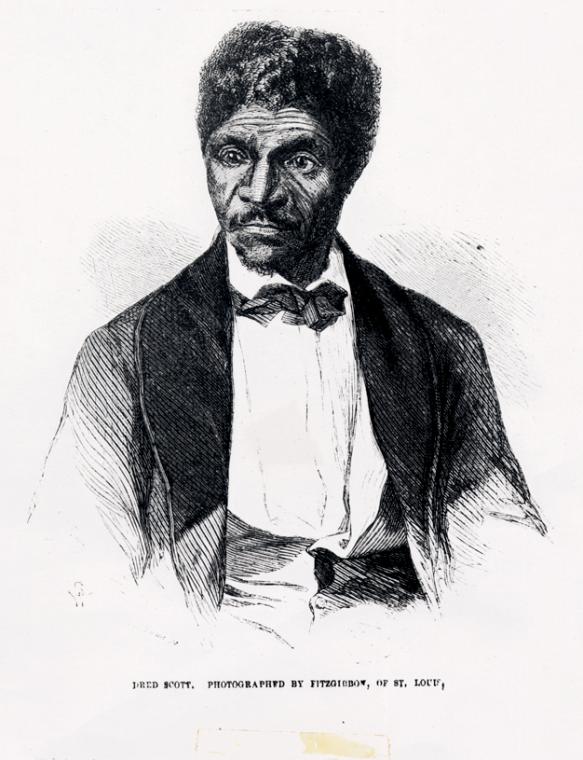
Dred Scott was an enslaved man of African descent who sued for his freedom in federal court.

Schomburg Center for Research in Black Culture, Photographs and Prints Division, The New York Public Library. Dred Scott Retrieved from http://digitalcollections.nypl.org/items/8604d9f9-99cb-3204-e040-e00a18063b35

Simplifying a bit, his basic contention was that because the man holding him enslaved had taken Scott with him to live in a federal territory in which Congress had prohibited slavery in the statute widely known as the Missouri Compromise, this acted to free Scott; that his continued enslavement therefor violated his legal rights; and that the federal court had jurisdiction over this lawsuit under the terms of Article III of the Constitution because Scott was a citizen of one state and Sanford who claimed ownership of Scott was a citizen of a different state.  In a 7-to-2 decision where each Justice wrote his own opinion, the Supreme Court ruled against Dred Scott. 

Chief Justice Roger Taney’s lead opinion became emblematic of the case, and it reasoned first that the federal courts had no jurisdiction because Dred Scott as a presumed descendant of enslaved Africans did not count as a citizen, because those who wrote and adopted the Constitution regarded such persons as so inferior they and their descendants could never be part of the body politic. This, constitutional scholar and now Princeton University president Christopher Eisgruber has suggested, may be the original “originalist” constitutional decision,* one insisting that the Constitution’s meaning must be strictly limited to what was intended or perhaps understood by those who framed it.  Second, Chief Justice Taney reasoned that Scott also lost on the merits because he was not made free by the sojourn to a free territory, because Congress lacked power to prohibit slavery in the territories; the territories had to have the same prerogatives as the states, and the states of course chose whether to be free states or slave states.  Taney also reasoned that not only did the federal Constitution contain no grant of power to Congress to forbid slavery in the territories, but that even if it did a law that freed a slave “merely” because a slaveholder took him or her into a free territory would deprive the slaveholder of property without due process of law.  Hence, the Missouri Compromise’s ban on slavery in specified federal territory was unconstitutional.

In his Obergefell dissent, Chief Justice Roberts argued that Justice Kennedy’s majority opinion was crucially like Taney’s ruling in Dred Scott.  Roberts did not argue that Obergefell was like Dred Scott in that both adopted originalist approaches to constitutional interpretation; that is not true of the Obergefell opinion and, to the contrary, Roberts’s dissent is fairly congenial toward originalism. Nor, given the factual context of Obergefell, could Roberts repeat the common anti-abortion analogy between Dred Scott and Roe v. Wade, that the opinions wrongly denied full legal status and constitutional protection of life and liberty to a dramatically powerless segment of the human population.  Nor was his criticism that they were similar cases in that it was as unjust to let same-sex couples marry as it was unjust to deny African Americans’ citizenship.  Fortunately few in the U.S. have expressly gone so far in their condemnations of Obergefell.

Rather, the Chief Justice’s invocation of Dred Scott rested on the same concerns about how to interpret the Constitution that made Justice Scalia apoplectic in Planned Parenthood v. Casey, where in 1992 a majority of Justices refused to overrule Roe v. Wade.  Like the Casey majority that protected a woman’s right to choose to terminate her pregnancy relied on the Due Process Clause, the Obergefell majority went astray in Roberts’s eyes in holding that the freedom to marry a person regardless of gender was a fundamental right protected by the Due Process Clause.  For Roberts, the actual right at issue, framed narrowly as a right to “same-sex marriage” – I am completely dismissing his laughable claim that the right the Obergefell plaintiffs were claiming was “a right to make a State change its definition of marriage” – was not protected by law throughout U.S. history and thus should not be protected by courts under due process. 

For Roberts, and I quote at some length: “The need for restraint in administering the strong medicine of substantive due process is a lesson this Court has learned the hard way. The Court first applied substantive due process to strike down a statute in Dred Scott v. Sandford.… The Court relied on its own conception of liberty and property in doing so.… In a dissent that has outlasted the majority opinion, Justice Curtis explained that when the ‘fixed rules which govern the interpretation of laws [are] abandoned, and the theoretical opinions of individuals are allowed to control’ the Constitution's meaning, ‘we have no longer a Constitution; we are under the government of individual men, who for the time being have power to declare what the Constitution is, according to their own views of what it ought to mean.’” So, Roberts objected to the majority’s holding the Due Process Clause to protect substantive rights unless it could show that the narrowly framed right to marry a person of the same sex was “‘objectively, deeply rooted in this Nation’s history and tradi­tion,’ and ‘implicit in the concept of ordered liberty, such that neither liberty nor justice would exist if they were sacrificed.’”

Brian Brown, head of the marriage inequality group the National Organization for Marriage (or NOM), also has used Dred Scott to criticize the Obergefell majority’s use of the Due Process Clause to protect same-sex couples’ access to civil marriage.  “In terms of its legal reasoning,” he wrote, “Obergefell v. Hodges[] is the Dred Scott decision of our time.  It is illegitimate and completing lacking in constitutional authority.  It is the product of unaccountable judges legislating from the bench, usurping the role of elected officials and voters and imposing a social policy on the nation because they think they know best.”

This version of the Dred Scott criticism of Obergefell, like Chief Justice Roberts’s, flatly ignored the great deal of precedent and doctrine with which the Obergefell majority opinion engaged.  Roberts and Brown may not have liked the majority’s interpretive approach, but it was well grounded in Supreme Court practice and far from lawless.  Ignoring this “Dred again” argument might thus be the appropriate response.  But it is not the only use of Dred Scott that people resisting marriage equality are making. 

Although the vast majority of those charged with issuing marriage licenses in the country are complying with the Constitution and Obergefell, there are a tiny number of persons like the over-exposed Rowan County Clerk Kim Davis who have refused to do so.  Some of Davis’s defenders have tried to justify her resistance by reference to President Lincoln’s example with respect to the Dred Scott decision.  Brian Brown of NOM wrote that “like Dred Scott, America need not accept [the Obergefell ruling] as the final word, the ‘law of the land’ or even a decision worthy of respect,” and he quoted President Lincoln’s first inaugural address: “‘if the policy of the government upon vital questions, affecting the whole people, is to be irrevocably fixed by decisions of the Supreme Court, the instant they are made … the people will have ceased to be their own rulers, having to that extent practically resigned their government into the hands of that eminent tribunal.’”  Similarly, Republican presidential candidate Mike Huckabee, defending Davis’s refusal to issue marriage licenses because of her religiously-justified belief that a same-sex couple cannot marry, claimed:  “Lincoln ignored the 1847 Dred Scott decision that said black people weren’t fully human.  It was a wrong decision.  And to say that we have to surrender to judicial supremacy is to do what Jefferson warned against, which is, in essence, surrender to judicial tyranny.”  And for Huckabee, ignoring odious Supreme court decisions is a patently appropriate response, a necessary response, because, he claims, “the Dred Scott decision … still remains to this day the law of the land.”

There is so much wrong with Huckabee’s Dred Scott defense of Kim Davis that it is hard to know where to start.  Let’s quickly set aside the fact that the case was decided in 1857, much closer to the start of the Civil War; Huckabee gets the date right elsewhere.  Let’s also set aside that Huckabee is apparently conflating the case with anti-abortion criticisms of Roe v. Wade, for, however disparaging it might have been, Dred Scott did not hold that black people were not fully human; it was about constitutional citizenship, not personhood.  Additionally, and this is harder to swallow, I realize, let’s set aside Huckabee’s profoundly ignorant claim that Dred Scott is the law of the land and so must be ignored.  The Supreme Court did not need to overrule that decision because, as Chief Justice Roberts pithily acknowledged in his Obergefell dissent, “Dred Scott’s holding was overruled on the battlefields of the Civil War and by constitutional amendment after Appomattox….”  The Thirteenth Amendment abolished slavery, the condition Mr. Scott unsuccessfully challenged, and the very first sentence of the Fourteenth Amendment guaranteed birthright citizenship to all regardless of race, thereby overruling the case’s primary, citizenship holding.

More fundamentally off-base as far as the Davis controversy goes, though, Huckabee is wrong to claim bluntly without qualification, repeatedly in multiple venues, that “Lincoln ignored” Dred Scott.  For the President took pains in his First Inaugural to note:  “nor do I deny that such decisions must be binding in any case upon the parties to a suit, as to the object of that suit.”  Lincoln never acted as though Dred Scott was a free citizen.  Indeed, he even went so far as to say – something opponents of Obergefell conveniently overlook – that even as to non-parties, the Supreme Court’s constitutional decisions “are also entitled to very high respect and consideration, in all parallel cases, by all other departments of the government.”

Let me be clear.  Kim Davis is one of the “parties to a suit” for access to civil marriage in Rowan County, Kentucky, and she was under a federal court order to issue licenses.  Her refusal to comply with that order while she was seeking its extremely unlikely reversal on appeal is thus in no way sanctioned by President Lincoln’s position on the permissibility of government officials who have not been bound by a court’s judgment not following Dred Scott.  Davis’s actions have been lawless, not in our constitutional order a lawful mode of resisting marriage equality.  And the American public sees it that way, with a new poll showing that almost two-thirds of respondents believe that Kim Davis should be required to issue marriage licenses to same-sex couples, and when asked more abstractly almost three-quarters of respondents believed in general that the obligation to treat everyone equally is more important than accommodating religious beliefs that conflict with the equality principle.

A constitutional amendment to override Obergefell would be a different matter from flat disregard of the decision, and it is another potential avenue of resistance to the Supreme Court’s constitutional interpretation there.  Dred Scott was overruled by two such amendments, the Thirteenth and Fourteenth.  Hypothetically, a Twenty-Eighth Amendment to the U.S. Constitution could be adopted to undo Obergefell.  There have already been calls for exactly that.  Recent Republican presidential candidate Scott Walker responded to what he sees as the wrong of Obergefell: “the only alternative left for the American people is to support an amendment to the U.S. Constitution to reaffirm the ability of the states to continue to define marriage.”  Republican presidential candidate Senator Ted Cruz takes the same position. Republican presidential candidate – anyone see a pattern here? – Rick Santorum one-ups them, espousing a federal constitutional amendment to limit marriage to couples with one man and one woman, echoing earlier anti-marriage equality proposals that would spawn a host of problems. Republican presidential candidate Mike Huckabee has agreed.  Indeed, the Republican Party Platform from 2012 calls for precisely such a marriage-defining amendment.  And of course the National Organization for Marriage says it will “[l]end support to other efforts to amend the constitution [sic] to repeal” Obergefell.

Not to be smug, but even without a crystal ball I am confident: It’s not happening, as Republican presidential candidates Jeb Bush and Sen. Lindsey Graham have recognized and so called for the Republican party to remove theanti-same-sex-marriage plank from its platform.  They understand that marriage for same-sex couples is not an issue that divides the people of the U.S. the way abortion has been. The country has been relatively close to evenly split over abortion, with fluctuations, since at least 1997.  Contrast marriage equality.  JulyGallup polling, about two weeks after the Obergefell decision, showed 58% of surveyed respondents supporting marriage equality (with only 40% opposing), not statistically lower than the numbers in May before the Court ruled.  Of equal importance, since Gallup started polling on the issue in 1996 support for marriage equality has been increasing, opposition has been decreasing, and support is highest among younger respondents, with more than three quarters of adults under 30 supportive in the July polling.  All indications are that opposition to marriage for same-sex couples is not simply a function of age, but rather of the time during which one grew up and formed early opinions. Younger people have difficulty understanding why so many have been hung up on keeping lesbigay people from marrying. And the younger people of today are the influential voters, legislators, and jurists of tomorrow. So perhaps this is an area where the Reverend Doctor Martin Luther King, Jr.’s observation rings true: “The arc of the moral universe is long, but it bends toward justice.”


* Christopher L. Eisgruber, “Dred Again: Originalism’s Forgotten Past,” Constitutional Commentary, Volume 10, Issue 1 (Winter 1993), http://conservancy.umn.edu/bitstream/handle/11299/166878/10_01_Eisgruber.pdf